Specialist Course - The Wild Geese & The Jacobites
Explore an extraordinary aspect of Irish history and living heritage with Richard. As a published historian of this fascinating niche of Irish history, he brings unique expertise to the table which touches on themes such as military history, identity, court studies, cultural memory, historiography and Irish language sources. This course will accept a maximum of 12 participants and will consist of a one-hour lecture, followed by 30 minutes of round-table discussion.
Running on Saturdays
November 7 to December 12 - 16:00 until 17:30 - €519.87 / $585 - Reserve your place now.
Lecture 1 - Who were the Wild Geese & the Jacobites?
In the introductory lecture, learn the background and context to the War of the Two Kings 1689-1691. What was Ireland like in the latter half of the seventeenth century? Why did the Roman Catholics of Ireland support James Stuart II? What were the major events of the war? What were the Articles of Limerick? What was the Flight of the Wild Geese?
Lecture 2 - The Irish Brigades in European Armies
What were the Irish regiments of France, Spain and the Holy Roman Empire? Who were their commanders? How did they perform on the battlefields of Europe during the Nine Years' War (1688-1697) and during the War of Spanish Succession 1701-1714? How was recruitment to the regiments maintained?
Lecture 3 - Ireland during the era of the Penal Laws and the Wild Geese
What were the penal laws and whom did they affect? What was the role of Irish language poets in maintaining loyalty to the Jacobite Cause? What was the role of the Roman Catholic clergy in maintaining the same loyalty? What forms of resistance were offered to the status quo facing Irish Catholics? How did the Anglican Protestants of Ireland maintain their grip on power during the period? How did the Irish thrive in Europe?
Lecture 4 - Sir Charles Wogan: the life and times of a dedicated Jacobite
How did Charles Wogan of Kildare become involved with the Jacobite cause? How did he manage to secure the dramatic rescue and escape of Princess Clementina Sobieska in 1719? How was Wogan honoured by both pope and king? What was life like for a military officer in Spain during the 1720s and 1730s? How did Wogan contribute the 1745 Rising in Scoland?
Lecture 5 - Cultural memory: surviving poetry, music & songs from the era
In this lecture you will learn about how contemporary Irish language poets maintained support for the Jacobite cause by writing both high-form classical compositions, and popular songs which could be spread rapidly through the country. The importance of the surviving Irish language poets as sources of history will be discussed. Specific pieces of poetry and music will be shared during the lecture with a special focus on 'Óró Sé do Bheatha Abhaile'.
Lecture 6 - European archives and source material workshop
In the final course lecture Richard discusses the various sources available to researchers of the Wild Geese and the Jacobites across Europe based on his own experience. This lecture will be particularly useful to those interested in entering this rich and fascinating research field. It will include discussion on the major scholars and works on the Wild Geese and Jacobites, past and present, and will show examples of source material with which Richard has worked.
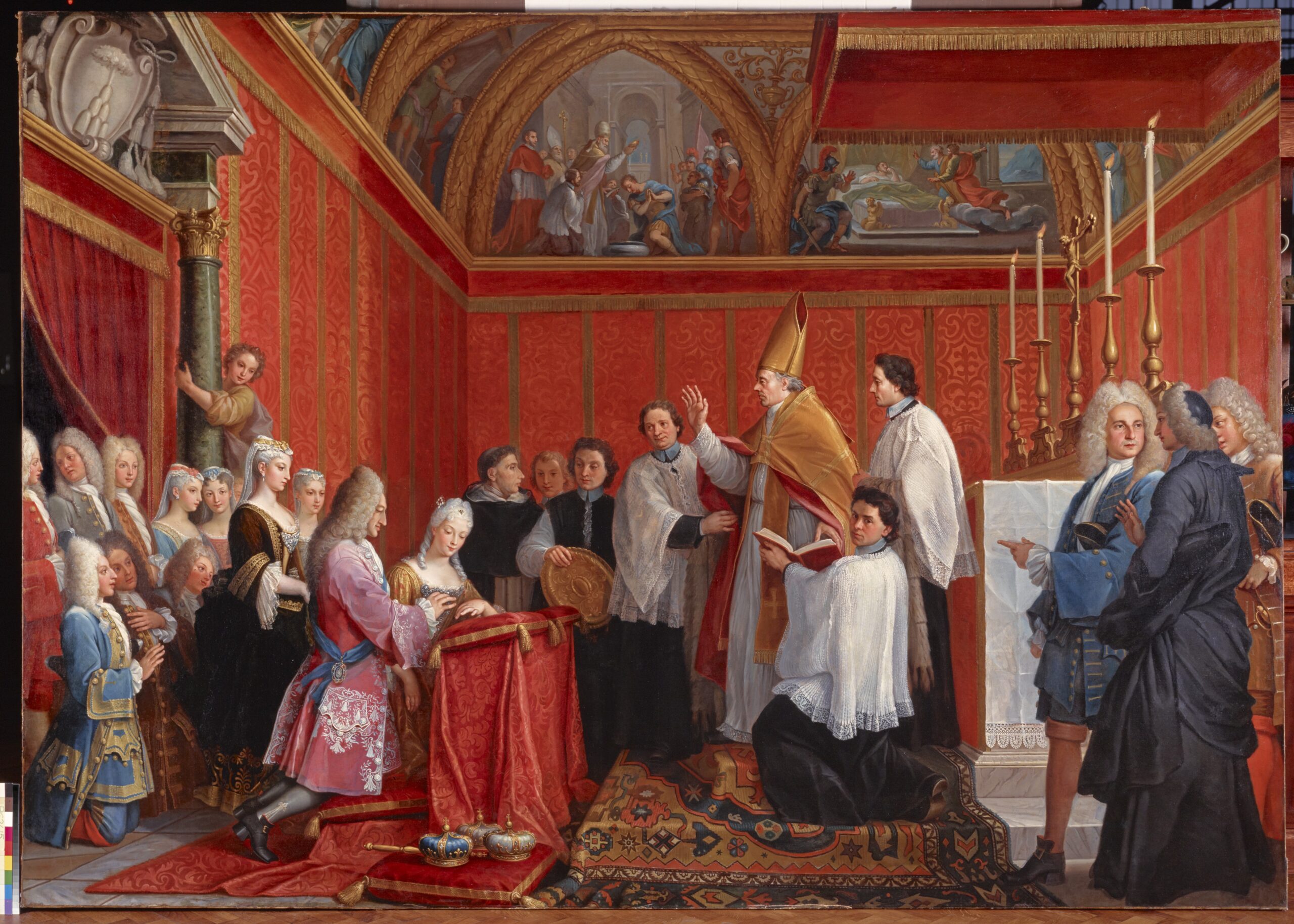
Agostino Masucci, The Solemnisation of the Marriage of King James III and Queen Clementina at Montefiascone on 1 September 1719, 1735